« How To Build an Empire Merely by Getting Your People to Do What You Want Them To Do | Main | I Want It! »
April 15, 2009
The Taxman, and Mexicans, Cometh
"Let it be known that British liberties are not the grants of princes or parliaments. That many of our rights are inherent and essential, agreed on as maxims and established as preliminaries even before parliament existed. We have a right to them derived from our maker. Our forefathers have earned and bought liberty for us at the expense of their ease, their estates, their pleasures and their blood. Liberty is not built on the doctrine that a few nobles have a right to inhherit the earth. No. No. It stands on this principle that the meanest and the lowest of the people are, by the inalterable, indefeasible laws of God and nature. as well entitled to the benefit of the air to breathe, light to see, food to eat, and clothes to wear as the nobles or the King. That is liberty. And liberty will reign in America."
-John Adams (or at least the HBO version)
Today is April 15th, and the occasion has produced the usual debate (see here or here, or pretty much anywhere) about taxes (or rather tax levels) in these United States. I've even heard talk or a Tea Party or two. No commentary on my part is necessary: if you are old enough to read this, your mind is probably made up one way or the other. (I have to admit that pushed to their logical extreme, I find both positions a bit silly.)
In other news, Mexican government demands that we renew the expired assault weapons (disclaimer: I have never really heard a satisfactory working definition of an assault weapon, and so use the term with great skepticism and only for purposes of consistency with the public dialogue on the subject) ban. The majority of the press is making sure everyone knows about the supposed situation and certainly appears to agree that the assault weapons ban should be renewed (eg here, here, etc.) or at least that something needs to be done (eg here).
I have to admit some degree of skepticism about the specifics regarding the factual claims the Mexican government is making to support their case. For instance, in his interview with Bob Schieffer, the Mexican Ambassador to the US made some really strange arguments to back the oft-repeated official Mexican line that 90 percent of the assault weapons seized from the cartels in Mexico originate in the US. For instance, when pressed by Schieffer to back this claim, he said:
"Look at the most recent large seizure in Reynosa, a town that is on the border. In November, in a military checkpoint, just about three or four kilometers into Mexican territory, we seized more than 250 assault weapons and half a million rounds of ammo. These had just crossed over the border from the United States into Mexico. By tracing back these weapons, by looking at the types of weapons, we're determining that most of these weapons are coming from the United States, Bob."
So, basically, if I understand this correctly, he is arguing that the US origins for most of the guns seized in a shipment of guns just arrived from the US is proof that most of the assault rifles in the hands of the Mexican cartels come from the US? I have heard other, similarly strange arguments when the 90 percent figure is challenged.
And I am skeptical that the expiration of/failure to renew the old assault weapons ban has somehow causally contributed to a surge in gun smuggling and assault weapons violence in Mexico. For one thing, I never got the sense that the old assault weapons ban represented more than a minor inconvenience to gun owners: the XM-15 that emerged under the ban in the place of the AR-15 was, for all intents and purposes, ....an AR-15. How could the expiration of something of so little real consequence make any such pronounced difference?
Before proceeding I should probably admit my great skepticism with assault weapons bans. I just don't think that a scientific case has been made that so-called assault weapons contribute sufficiently (from a statistical standpoint) to crime or violence in the US to restrict the legal right to own them. Indeed, it seems to me that at the base of the arguments for renewal or extension of the assault weapons ban that most proponents put forth is a sense that they just do not think that people should be allowed to possess these weapons per se. But that strikes me as rather like the argument that gay marriage should be banned because one just does not think it is proper per se: offended sensibilities are not an argument for curtailing freedom. At least not if you want America to remain free. If you want to curtail a freedom or privilege, you really need to show a clear, compelling and significant social cost, as opposed to simple personal opposition in principal. And I don't think the opponents of either assault weapons or gay marriage can do that.
Moreover assault weapons ban proposals have generally struck me as overly broad. For instance, the M1a (the civilian variant of the old M-14 rifle, which is in turn the heir to the M1 Garand) would be characterized as an assault weapon under most of them. But is banning this weapon reasonable? How many homicides in the US can be linked to the M1a in the last decade? I would bet hardly any (when I tried to search online, I could find only one example, and it was a murder in the Philippines committed with an actual M-14; indeed, it seemed from my casual research that the vast majority of assault weapons used in crimes were AK-47 variants, with AR-15 variants a very distant second).
However, by contrasting the track record of the M1a with the AK-47, one interesting compromise way forward becomes apparent. Put simply, the M1a is as potentially devastating a weapon as the variants of the AK-47 legally available for sale in the US (these are semi-automatic, though admittedly could potentially be illegally rendered automatic). The M1a fires a more powerful round (classic AKs take the 7.62X39mm round while the M1a chambers the bigger, harder hitting, longer range 7.62X51mm/.308 Winchester round), is more accurate and is at least as reliable (the AK's reliability is the most oft-cited source of their appeal). Moreover, just like the AK-47, there are relatively compact, carbine-esque variants of it (such as the Springfield SOCOM rifles). Compared with the AR-15, both have a kick and neither is particularly easily modified.
But when I hear about crimes with assault weapons, either in the local or national news, the AK-47 is always front and center, and the M1a is missing. Why? The biggest difference between the two weapons in terms of attractiveness to criminals (as I explained, they are technically similar weapons in many respects, and where they differ the M1a usually has the advantage in terms of potential lethality) would seem to me to be price. Until the arrival of President Obama made the gun-buying public fear that AKs would be at the top of the hit list for the new administration, a good AK could be had for $300-$350 (prices are now often a couple hundred dollars higher, but will probably fall once the "Obama panic" recedes). By contrast, you would be hard pressed to find a good M1a for less than $1400-$1500, and many sell for $2000 or more.
But where do these AKs (and other guns more commonly used in crimes) that appear in the evening news at crime scenes or on tables at the Sheriff's department post-seizure come from? It seems to me that two sources are responsible for a disproportionate share of the AKs and other guns used in crimes: gun shows in states with a so-called gun show loophole (basically excusing certain types of vendors from running background checks at gun shows) and particular dealers (I have noticed that in virtually every journalistic expose on the sources of guns used in crimes, they note the plethora of dealers but their evidence seem to suggest that certain dealers are quite popular with criminals) or purchasers who act as front men for criminals (or, I suspect is quite often the case, some collusion of such dealers and front men).
We are now at a strange cross-roads. We have a group of Americans who feel helpless at what they perceive to be bewildering levels of gun crime in the US and Mexico: for all intents and purposes, it would seem that a Democratic congressional leadership all to aware of the appalling political cost of the last assault weapons ban is unwilling to pursue one now. So these people (the Rep. McCarthy types) in some sense have gone for it all and ended up with nothing. But, American political tidal patterns being what they are, this is likely not their last bite at this apple.
On the other hand you have a group of Americans who feel that a cherished constitutional right is threatened, and by other-than-constitutional mechanisms. Their absolutist outrage may be a bit overblown (I tend to accept their interpretation of "militia" in the second amendment, but would remind them that the words "well-regulated" are also clearly present). But their fear may not be completely unreasonable: perhaps a permanent assault weapons ban would be simply the first step in a longer term agenda to completely erode the second amendment by legislative means (a prospect that should given anyone who care about the Bill of Rights pause, even if they don't care for guns). But I sort of doubt that is true of a majority of the supporters of a assault weapons bans: I think most of these people really fear assault weapons, and do not seriously entertain fantasies about completely disarming the American populace.
It seems to me, however, that there is a way that maybe both sides can be satisfied. Rather than take the rancorous, potentially constitutionally questionable (how far that "regulation" can go and not unconstitutionally render the right hollow is an interesting question) and, for now, certainly politically infeasible route of an assault weapons ban, might I suggest the following compromises:
1. Tax Assault Weapons. Specifically, introduce a tax that works as follows: whatever the difference between the pre-tax retail price of the rifle and $1300 (the rough floor price for an M1a), close the gap with a tax that makes the post-tax price $1300. This would be more politically salable (the really politically influential domestic assault weapons manufacturers, such as Bushmaster, Springfield, etc. would be presented with very interesting incentives in terms of whether to oppose such a measure, since most of their rifles already cost that much or more). I choose $1300 because the track records of the AK-47 and M1a in crime suggests that whatever the prohibitive price level for most criminals is, it is certainly $1300 or less. And taxation is perfectly fine: we tax everything in this country anyway.
2. Close the gun show loophole. This one is a no-brainer, and I don't even think the NRA or the vast majority of gun owners would fight it.
3. Increase oversight of and reporting by dealers. This addresses a favorite tactic of criminals: using a front-person with no record, lax gun dealers, or both to purchase those guns not bought through a gun-show loophole. Force dealers with FFLs, or federal firearms licenses (the initial source for virtually all new guns that come into circulation), to adopt a new record keeping regimen. Under this scheme, all gun dealers would have to report any multiple sales to the same individual within some reasonable time frame to the ATF or risk their license. The problem with this safeguard is that criminals will respond by shopping at multiple dealers to spread out their purchases. But it will certainly reduce the problem of particular dealers with lax screening who become preferred sources for criminals. To address the problem of using multiple dealers, all FFL dealers would report all sales to an industry-supported database (through taxes or FFL fees) that provides enough information about sales to allow the ATF to spot potential criminal patterns. The information might include the type of gun, the first and last initials of the buyer or the last four digits of their social security number, state and county of residence, age, race, and date of birth. Note that this is not a registry of gun owners that the government could use to support an eventual confiscation. It is simply enough information for sophisticated computer algorithms to spot suspicious buying patterns and target the dealers involved for further audits of these particular transactions to figure out exactly who is behind these suspicious purchases (who needs 30 Glocks in a 6 week period?).
I am not saying these measures would stop all gun crime, but I think they would seriously disrupt the channels by which guns from the US have ended up in the hands of criminals (domestic or foreign). As such, I suspect they would be more effective than an assault weapons ban which would almost certainly be gamed by the gun industry.
So why can't we agree to a course like this? I think it is basically about the erosion of trust that is the toxic legacy of America's "culture wars". If most gun owners really believed that such reforms were an isolated set of initiatives, and not part of some longer term agenda to destroy the second amendment, I think they could agree to them. At the same time, I think many gun-control advocates are suspicious that such marginal measures will become subject to exactly the kind of exploitation of loopholes and gamesmanship that happened under the original federal assault weapons ban, though I doubt that would be the case. And in any case some reasonable legislative flexibility could be introduced about tax levels, reporting requirements for dealers, etc. that might otherwise be gamed by criminals if they weren't somewhat adaptable.
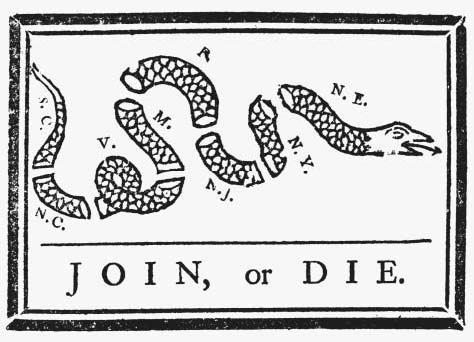
So what is my point? I guess maybe that "Join, or Die" was an unfortunate founding slogan for a Republic that would need to embrace many viewpoints, and preserve trust as an essential ingredient of compromise.
Posted by dag at April 15, 2009 3:28 PM