« Lindemans | Main | A good story »
January 21, 2006
Matoaka, we hardly knew yee...
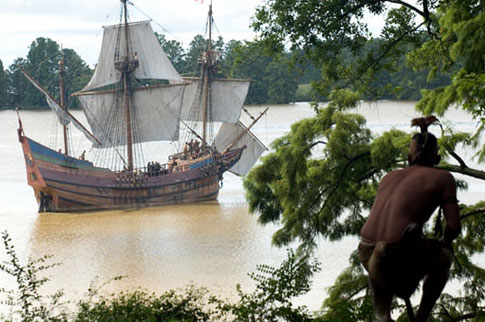
Last night I saw Terrence Malick's The New World, which essentially revolves around the life (indeed the stunning personal journey) of Matoaka/Rebecca Rolfe* (better known to us by her nickname Pocahontas) following the founding of Jamestown, Viriginia in 1607. This is a stunningly beautiful film, and while there are within it many parallels to Malick's earlier work (for example, any number of shots, scenes, visual metaphors, etc. reminded me of elements of The Thin Red Line), in no other sense does it rest on tired moviemaking convention. The photography (not only of the comparatively pristine natural paradise that was 1607 Virginia, but also of the dirty streets and ordered, expansive gardens of Stewart England) is mesmerizing. It is the stuff we have come to expect from Terrence Malick.
The acting is of the highest caliber. I was surprised at Colin Farrell's effective performance as a rather shifty and jaded John Smith completely awestruck by this innocent but intelligent, self-possessed and beautiful child of nature and her seemingly pristine world. He loves her in the most instinctive way (the emotional connection between Smith and Pocahontas is convincing, and gives the film all of its compelling energy through the lengthy but beautiful phase covering Smith's captivity in Pocahontas's village), and yet he knows that he and all that he represents will be the death of this pure beauty's primeval paradise. In one of the most tender moments of the film, she visits him at the Jamestown fort in winter, and plaintively asks why her lover had not come for her. The enormous sadness in Smith's eyes betrays both the devastation at having to separate himself from her and her beautiful village (returning to the disgusting and harsh fort, which serves as both crude military protection and prison) and a terrible sense of foreboding for her and her world. He knows that his love can only endanger her. In another scene, Smith marvels at the possibilities of this virgin land, but always with the same hint of sadness: he knows too well that men cut from his cloth will manage to screw up paradise.
Christian Bale turns in an earnest interpretation of John Rolfe as the kind of man who, while unable to turn back the clock and save the world Pocahontas came from, can offer her a loving and honest shelter from the terrible upheavals that await. Christopher Plummer...well, never mind: the quality of his work goes without saying.
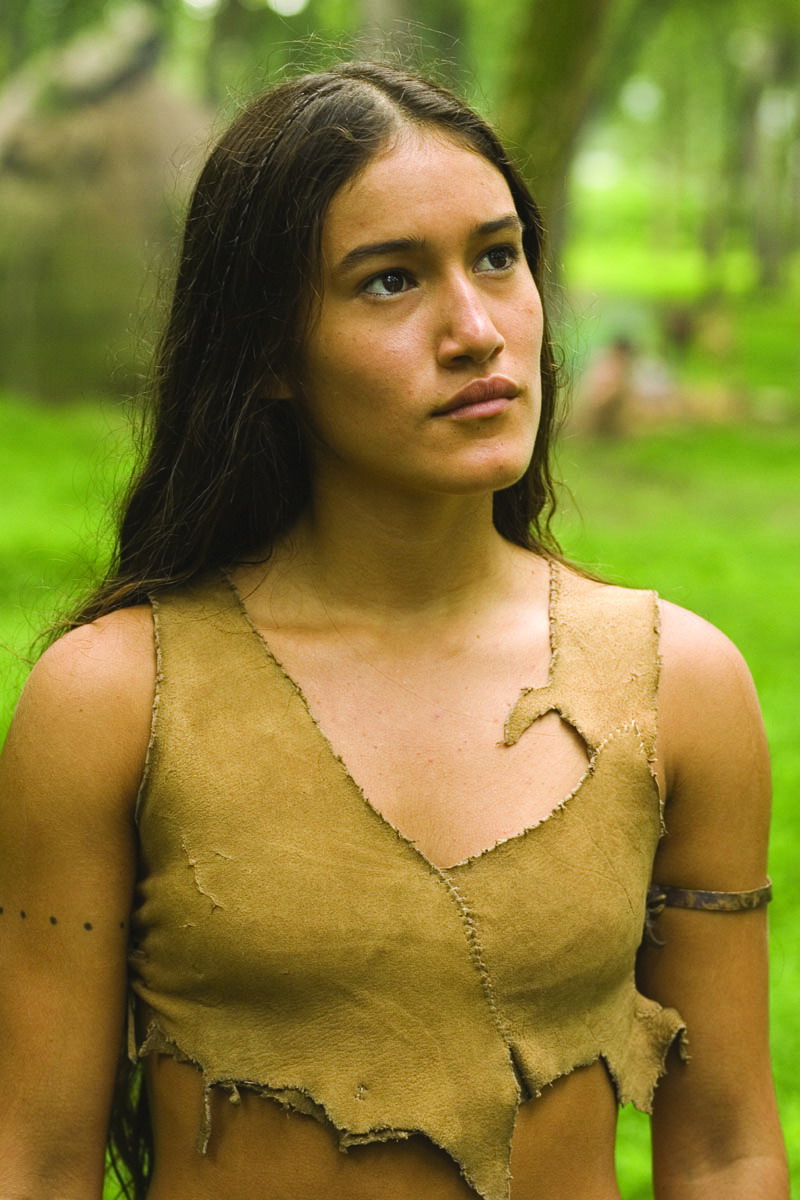
And, finally, we have the absolutely wonderful and refreshing newcomer Q'orianka Kilcher, as Pochantas. She proves herself to be a tremendous natural actress (the expression she wears as she learns that John Smith has died at sea is one that I will not soon forget). The interesting thing about her face (she is pictured below) is that, as with Penelope Cruz, she really does not have a single beautiful feature (at least in a conventional sense), and yet the whole is somehow wonderfully greater than the sum of its parts, creating a beauty for the ages. Her physical language is exactly in tune with the rythm of the character, as a playful natural spirit is gradually worn down by life. She never loses her sense of herself, but a certain spark, energy,... does somehow, sadly, disappear with time. This makes all the more effective and engaging the closing scene, as we see the recently deceased Rebecca Rolfe dancing freely and with the lightness, grace, energy and synergy with nature that we had witnessed in the young Matoaka.
Pocahontas is a character who simply will not fade from our imagination. Though the actual historical person is largely lost to the time fog and our notion of her has certainly been influenced by a considerable degree of romanticization in the centuries since she died, it would seem fair to suspect, from what first-person records and recollections of her that we have, that she was one of those rare people with the capacity to awaken something in those who encountered her (the sort that creates their own brilliant energy and then bestows it on others), and after she had gone they were never quite the same. That she did this at such an awful turning point of history is probably only further testimony to the power of her spirit. Kilcher simply inhabits this image of Pocahontas. She leaves the kind of impression on us that the historical person apparently did on Rolfe and others.
I think the key to this film is the discipline with which Malick remembers that to those whose story is being told (as opposed to us, the viewers, who know the old and sordid history of what followed), these really were new worlds. He captures that truth at every level of the film. In fact, he manages the difficult trick of capturing a moment of curious innocence, and getting us to buy into it, without trying to lull us into abandoning our sense of foreboding about what is to come. To be sure, this movie has irritating aspects (for some reason the opening credits seemed almost as long as your typical closing credits, which in the context-ie having already sat through interminable previews for other films-somewhat vexed me), and if you did not like films such as The Thin Red Line, I doubt you will care for this one. And it has its genuine `structural' (for lack of a better word) mis-steps. For instance, the film loses some of its rythm in the phase set in the fort during Jamestown's first, and most precarious, winter. The whole idea of 'the Fort as Harsh Prison to Contrast with the Freeness of Pocahontas's Sylvan Paradise' is overplayed, and it takes the film a little while to recover its level of emotional engagement. Aside from screwing up the pace of the film, this interlude is also unneccesary: this is really the story of Matoaka/Pocahontas/Rebecca Rolfe, not John Smith. As with films like The Thin Red Line, Malick sometimes has problems maintaining narrative focus.
Nonetheless, as with the The Thin Red Line (a beautiful, elegiac meditation on the horrific violation of another primeval paradise during the battle of Guadalcanal), The New World is a stunning masterpiece. I still need to reflect on it more before writing a full review, but it is inconceivable (especially the way that things have been going in Hollywood) to me that The New World will be displaced from my Ten Best list for the year.
*Interestingly, however, I can't recall Kilcher's character every actually being referred to by a name until she becomes Rebecca Rolfe, symbolically joining the West in the process. And maybe that's half the point: Malick feels that names are one step away from boundaries, limitations, property, and he perhaps feels that that is not what her world was like before we came.
Posted by dag at January 21, 2006 12:47 PM
Comments
Very many thanks for a good work. Nice and useful. Like it!
Posted by: Hanz Jocker at July 31, 2006 7:56 AM