« How do we begin to covet? | Main | Currently »
September 19, 2008
The Assassination of Jesse James by the Coward Robert Ford
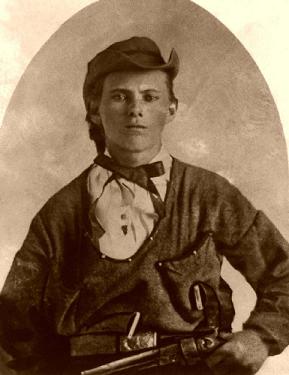
Yesterday the wife brought home a little surprise for me: the DVD of the recent (2007) film The Assassination of Jesse James by the Coward Robert Ford. Beautifully photographed (the bleak, hardscrabble landscapes somehow reminded me in their emotional impact of similar shots of the Kansas back-country in Capote), it provides a rather languid and melancholy, but ultimately engaging and compelling, stroll through the final days of the legendary outlaw.
And what a legend it is. Jesse James is a name that has proven to be an astonishingly durable American cultural icon (in some important metaphorical sense, the man is essentially un-killable). Certainly no one can completely understand the American South, including its enduring resentments, without breaking down the Cult of Jesse. And he is a hero to more than just one Lost Cause: by so conspicuously focusing on Jesse's efforts at terrorizing the central economic institutions of the Gilded Age (eg the railroads), his legend spoke to resentments that extended well beyond the tribal battles of Jayhawkers and Bushwhackers to a broader Jeffersonian America that was frankly already receding long before Jesse was born.
Perhaps that is what ultimately separates Jesse's image from that of, say, La Cosa Nostra (the only other realm of the underworld that has been glamorized to anywhere near the same degree by mainstream popular culture): where the Tony Sopranos of the world had merely style and bling, Jesse also represented, or has at least been presented as representing, a cause. The only problem with all of this, and it is a trap that The Assassination of Jesse James by the Coward Robert Ford falls into as well to some extent, is that it is not clear that any of this had anything to do with the historical Jesse. Indeed, while it essentially avoids any additional mythologizing that might further inflate his legend, the film also selectively navigates the fragments of the historical record (for instance, essentially omitting Jesse's tendency toward a racism that spilled over into psychosis) in a fashion that preserves some ultimate sense of sympathy with Jesse from a modern viewpoint.
But this isn't really fair to the film. It opens late in Jesse's life, when the forces that shaped him as an individual (the personal experience of slavery, Bleeding Kansas and the attendant civil strife in Missouri, the guerrilla warfare in Civil War Missouri, reconstruction and the economic realignment following the Southern defeat) and fueled his legend (a nascent tabloid celebrity culture that glamorized him, but in doing so also subtly appealed to lingering resentments from all of these historical events) had already conspired to generate the mythological presence that has more or less persevered to the present day. The point is that, as the film opens, Jesse is an established celebrity, with a persona that has inevitably eclipsed his actual personality.
It is as a study of this celebrity, and particularly its' role in shaping the psyche of his assassin Bob Ford, that this film should be approached, rather than as any kind of polemic about the real Jesse James. Bob, whose older brother Charley was a minor player in Jesse's gang, has lived a frustrated existence at the periphery of his idol's universe. (One of the unmistakable undertones of the film is the slightly homo-erotic quality to the pathetic Bob's worship of Jesse). When he finally gets his opportunity to penetrate the world of the rapidly disintegrating James Gang, it is only by dint of Jesse's growing paranoia, which Bob does not recognize at first because he cannot see through Jesse's persona. Ultimately, of course, that facade does come crashing down and Bob finally sees Jesse as a real, flawed person, leading to a sense of betrayal that sets their final death dance in motion.
Along with it's photography and well designed soundtrack, the film is held together by it's performances. Brad Pitt delivers a Jesse that appeals to both the legend and those critical of it, which is to say that in some over-arching sense he probably gets pretty close to who Jesse really was: a highly intelligent, attractive (in many senses), increasingly paranoid and occasionally psychotic man possessed of the kind of frightening charm and charisma, as well as tactical and strategic savvy, that allows one to maintain a criminal enterprise and stay just ahead of the law for an astonishingly long time, in the process enriching oneself and consciously participating in the birth of a legend. (Jesse seems to have been one of those rare, amoral -which is to say gifted, in modern Hollywood- characters who seemed to be able to effortlessly transcend the old conflict between doing well and doing good by realizing that when you are a celebrity, the latter is really just an element of the former, and as such need not be substantive as long as it is recognized). Casey Affleck turns in a brilliant performance as the fundamentally pathetic failed seeker Bob Ford. His performance is not to be missed, and hopefully serves as an early example of a kind of acting brilliance that will follow him through his career. Finally, the film is convincingly fleshed in by a number of superb cameos, including Sam Shepard as Jesse's more conservative, dour older brother Frank, who never understood celebrity the way that Jesse instinctively did, but did have the good sense to embrace the essential wisdom of Kenny Rogers The Gambler (and roughly a century before the song was released!). I also particularly enjoyed James Carville's Governor Crittenden (I'll remember his warning that Jesse's "cup of iniquity is full").
The Assassination of Jesse James by the Coward Robert Ford is well worth sitting through what would otherwise be an agonizingly long run-time (of something on the order of 160 or more minutes).
Posted by dag at September 19, 2008 9:06 PM