« A Joke, Comrade | Main | The National Champoins »
April 3, 2006
Bun Thit Nuong
Earlier this week, we grilled a hot weather favorite: bun thit nuong. Although this dish is often made with pork, my wife's family prefers to use beef. Filled with freshly de-skewered grilled beef, this dish is extremely tasty and filling and yet, with its cool salad-like quality, a very refreshing choice for the sort of summers we have around here, where the weather burns and, more often and worse still, scalds.
Anyway, the first step to making bun thit nuong is to have your wife and mother-in-law argue for several hours about how the dish should be made. You see, in the time honored tradition of the heirloom family recipes that make up the bedrock of our American ethnic culinary tapestry, we had a "two Vietnamese/three opinions" kind of situation in the kitchen.
Getting down to brass tacks, the next step is to prepare the meat for marinade. This is pretty simple. Take 3lbs of beef-it should be some cut with a decent amount of marbling-and cut into 1" strips and place in a container (such as a medium to large sized piece of tupperware) in which you can let the meat marinate in your fridge. (If you prefer pork, just use a similarly endowed 3lb cut of pork. In either case, another tack would be to have the 3lbs come from a number of different cuts to achieve your desired level of fat. My wife often combines London Broil and chuck roast in this recipe.) Cut several large onions into chunks large enough to be skewered, chop up a bunch of garlic (don't hold back here) and toss in with the meat. Then give it a sprinkle of sesame seeds, enough so that their presence is clear, but not so much that the eye and palate are drawn particulalrly to them. As you can see below, we largely forgot the sesame seeds.
Then prepare the marinating liquid by combining 2 tablespoons of vegetable oil, 3 tablespoons of soy sauce and 1/4 cup of sugar dissolved in 1/2 cup of water in a bowl. Add in salt and pepper to taste (again, be generous here). Mix throughly and toss in with the meat. Toss the meat through to insure a more even distribution of marinating liquid, garlic and onions.
Let marinate in the fridge for at least 1 day.
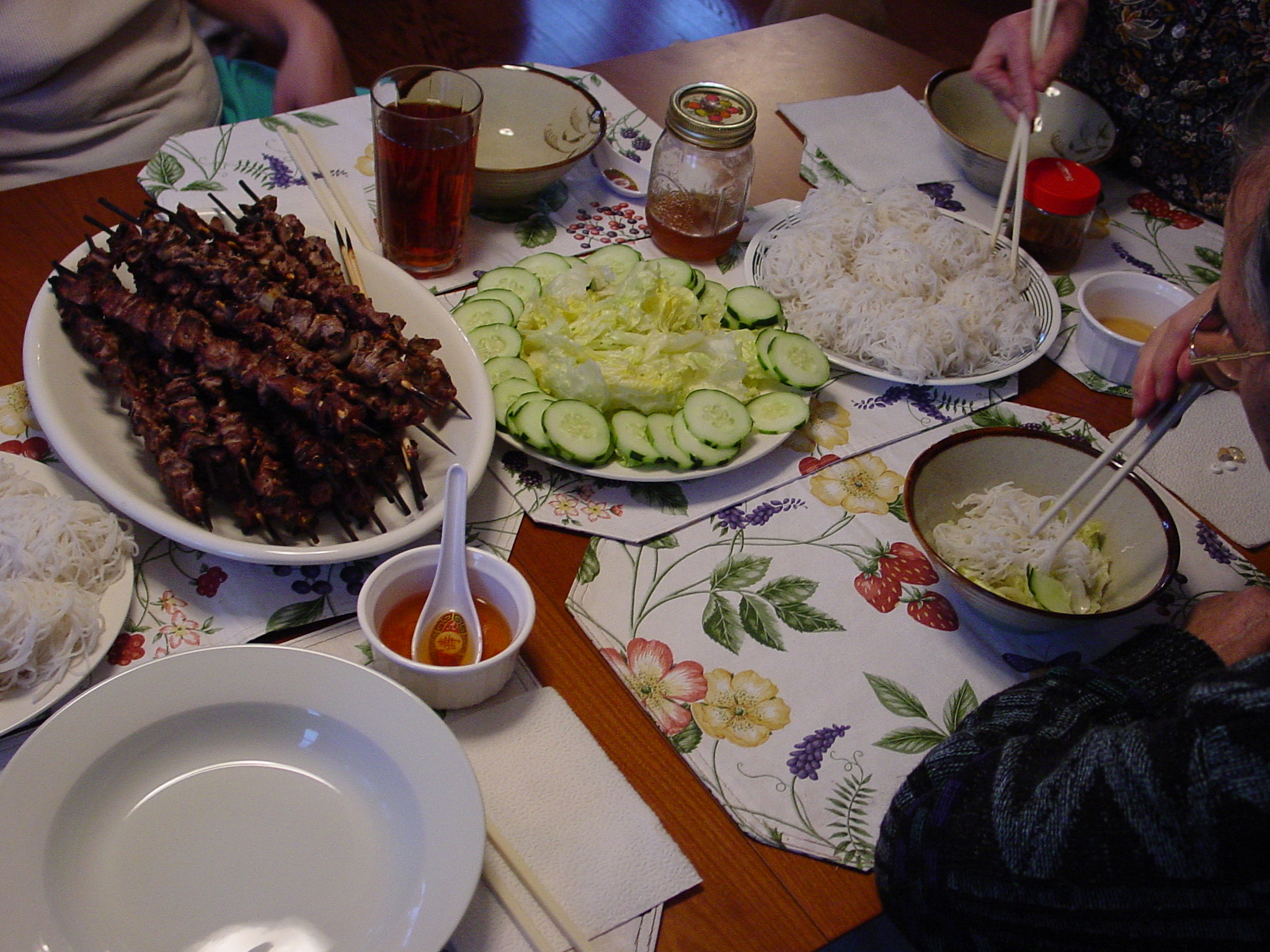
Once the meat has marinated, it's time for payday. First, you need to prepare a few things that will be combined with the meat once grilled. You can see these in the last picture in this post. A list of essentials might include:
1. Salad greens. We prefer lighter colored ones.
2. Thin white Vietnamese noodles (I don't what the hell they are called: see the noodles in the last picture on the last page). (My wife says that they are called bun and are available at any Vietnamese store.) Once they are boiled put them in a collander and run through with cold water. Then place the collander over a large bowl so the noodles can drain. Before serving, roll the noodles into little nests (shown) that make it easier for people to retrieve their desired amount from the common platter.
3. Sliced cucumbers.
4. A nuoc mam (fish sauce) based sauce to lubricate it all. The formula we use is to mix 1 cup water, 1/4 cup nuoc mam, 1 tablespoon lemon juice, 1/3 cup sugar and 2 teaspoon garlic pepper sauce in a jar. This should keep for about a week (in the fridge).
Once you have these in place, it is time to begin skewering the meat. Always use wood skewers.
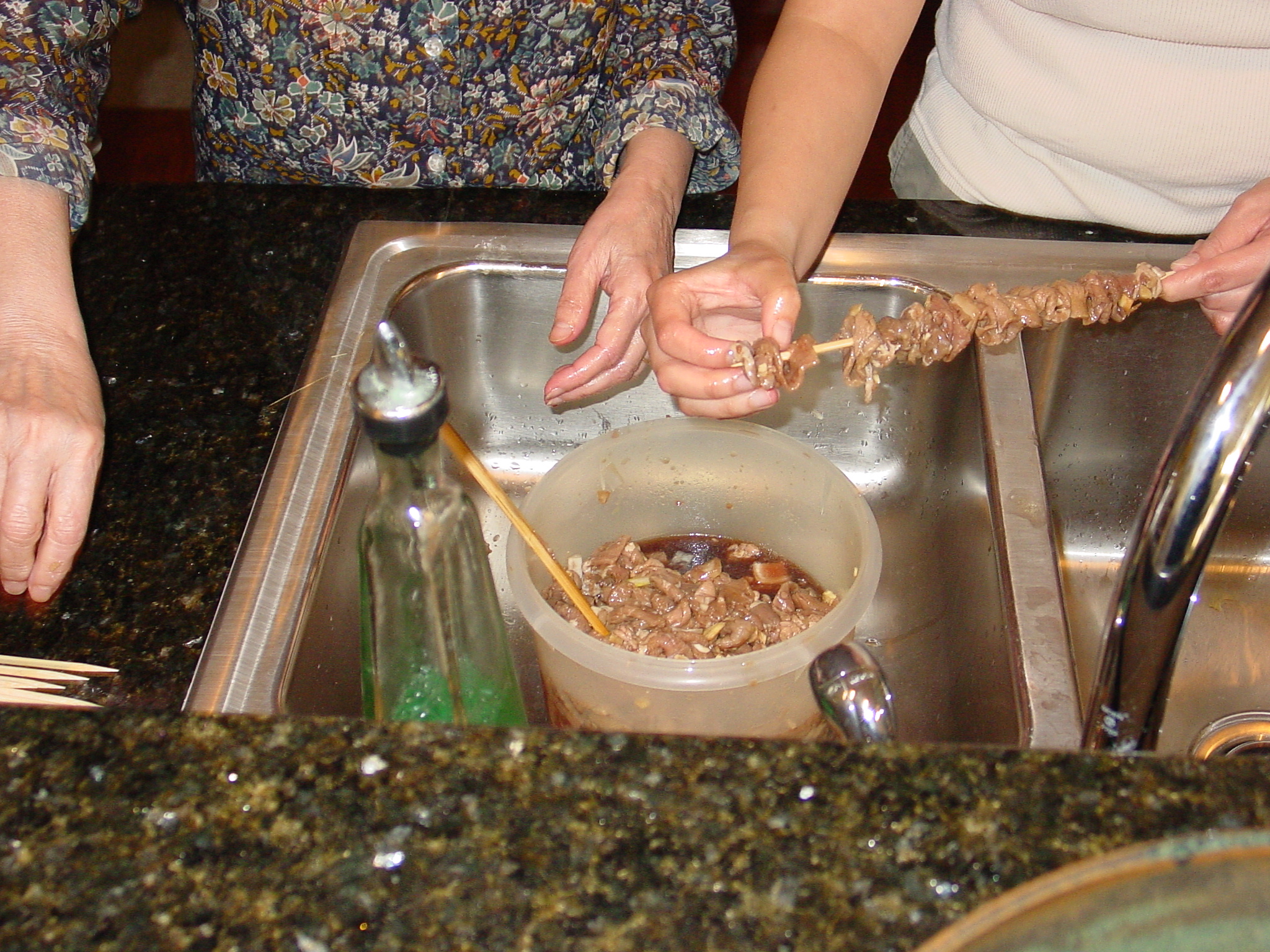
Once the meat is nearly all skewered, it is time to light the grill. Here is where the disgracefully aging gentleman enters the picture. Why? Because I am a maaaaaaaaaan. As Ron Burgundy might have put it: "I am a maaaaaaaaaan. I build fire. I read the news....and I like scotch. Scotch! Scotch! Scotch!"
Now, before proceeding, we need to establish a basic principal: I do not believe in propane and propane accesories.
I am a charcoal man through and through. I have heard, and accept, all of the arguments about why gas might have some advantages. But all of these benefits come at one big price: taste. If convenience is the main guiding principal in your life, you should just go to McDonalds for dinner anyway.
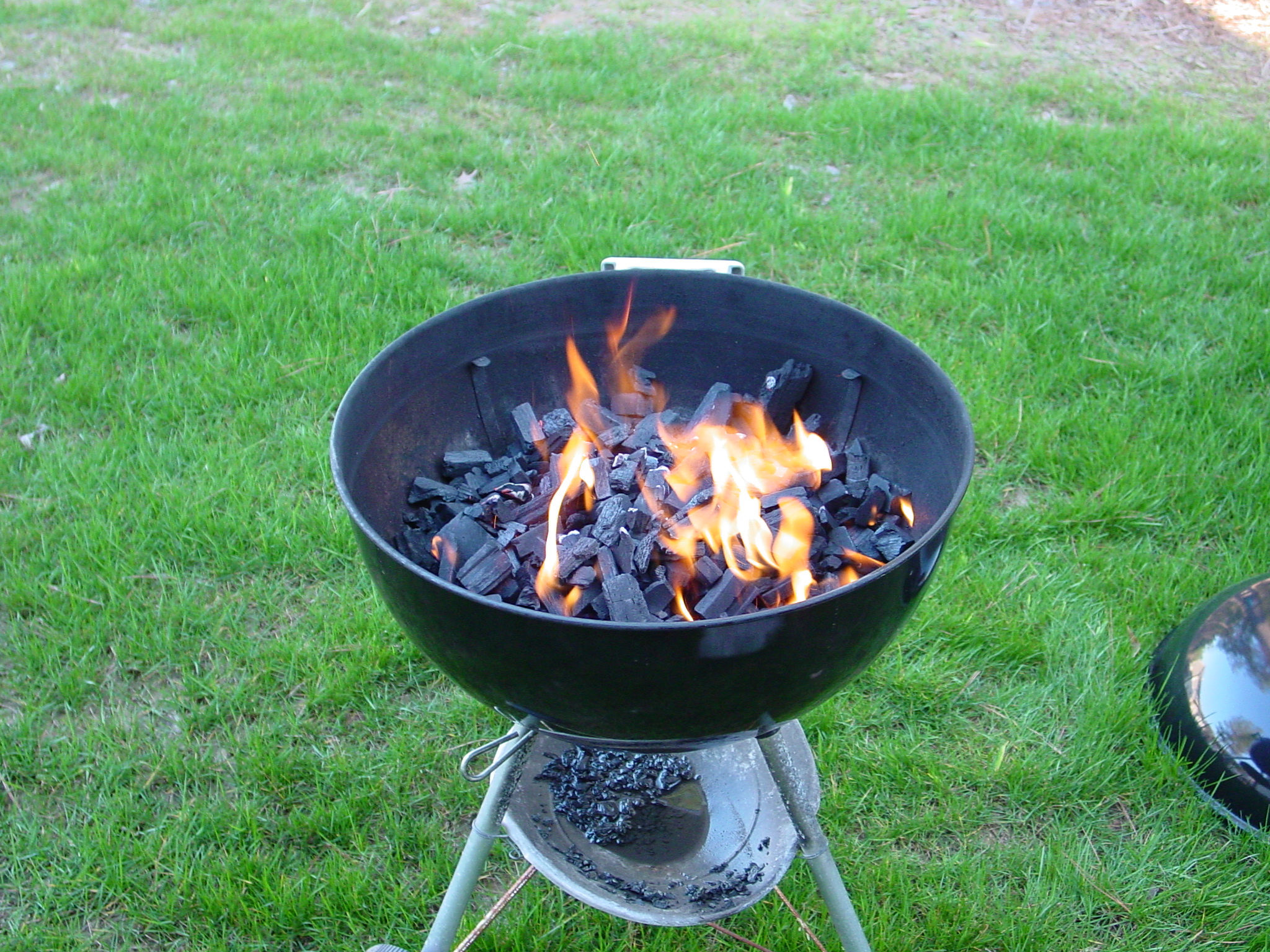
So, pour plenty of charcoal (I use Whole Foods organic harwood charcoal, because it burns hotter and faster and imparts a certain credible kiss of smoke) in your grill: you are going to want a hot fire here. Next, pour in plenty of charcoal lighter fluid to start the fire. Do not believe all of the stories about how it screws up the taste. 99.99999999999999999% of the fluid will burn off by the time the coals begin to settle down. If you do not believe me, try a blind taste test with one of these "no fluid" radicals. Also, try starting the coals evenly with newspaper or tinder and see how easy that actually is, unless you want to waste time with one of those chimneys (which are generally too small for the number of coals needed in this kind of recipe and, in any case, should be stored in a hallowed place until they are brought out for real barbeque, by which I of course mean slow smoking over hickory, cherry, etc.).
Anyway, at this point I offer some porno for pyros. While I watched the fire, Louie the Bull came out on the porch to oversee the process, as he tends to do. The moment he hears the grill move, he knows that very, very soon meat will be put to heat and it is time to begin crafting his begging strategy.
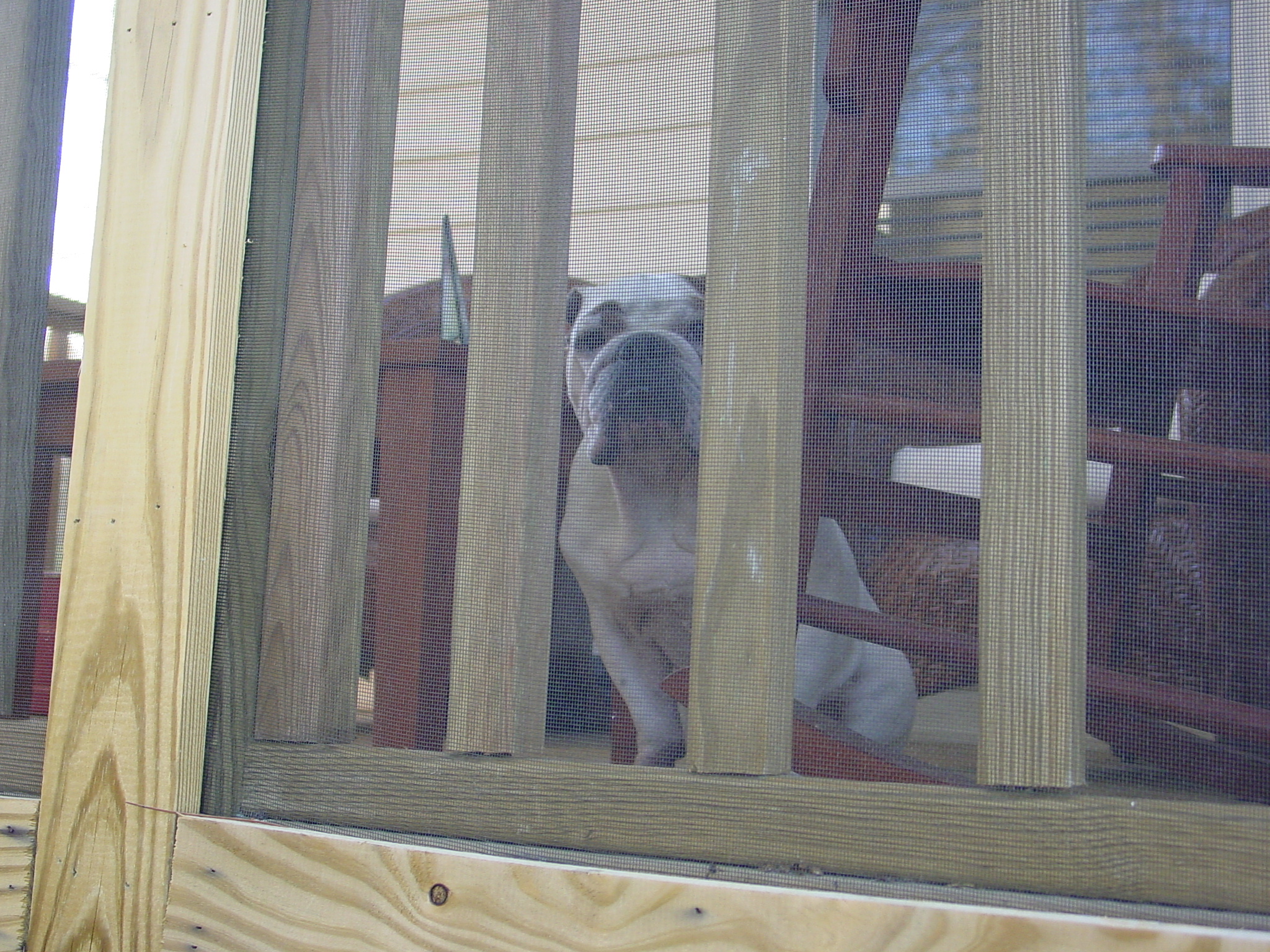
That's just the kind of edge that millions of years of instinct provides.
Let's return for a moment to the porno for pyros. I sort of fumbled on this one: I did not use enough charcoal or fire up what I did use consistently enough (thus maximizing the heat from the coals). That can't be helped: the first few grills of the season are always a dicey exercise in regaining rythm.
And building rythm is never easy for me: after all, I am a white man.
The point is that you want a really intense fire for this recipe, so that you can get a real crisp, carmelized exterior without overdoing the interior. A tiny little strip of pinkness inside each piece of meat is fine and desirable. Using too few coals, as I did, results in meat that cooks too slowly and thoroughly, and thus a product that is a bit too tough and dry.
Once you have the coals where you want them, it's time to cook the meat. If the fire is right (and, again, it wasn't in this case), the meat should need no more than 2-3 minutes on each side (each skewer need only be flipped once) to achieve a beautiful level of external doneness. To get an idea of what that should look like, look at the last picture in this post.
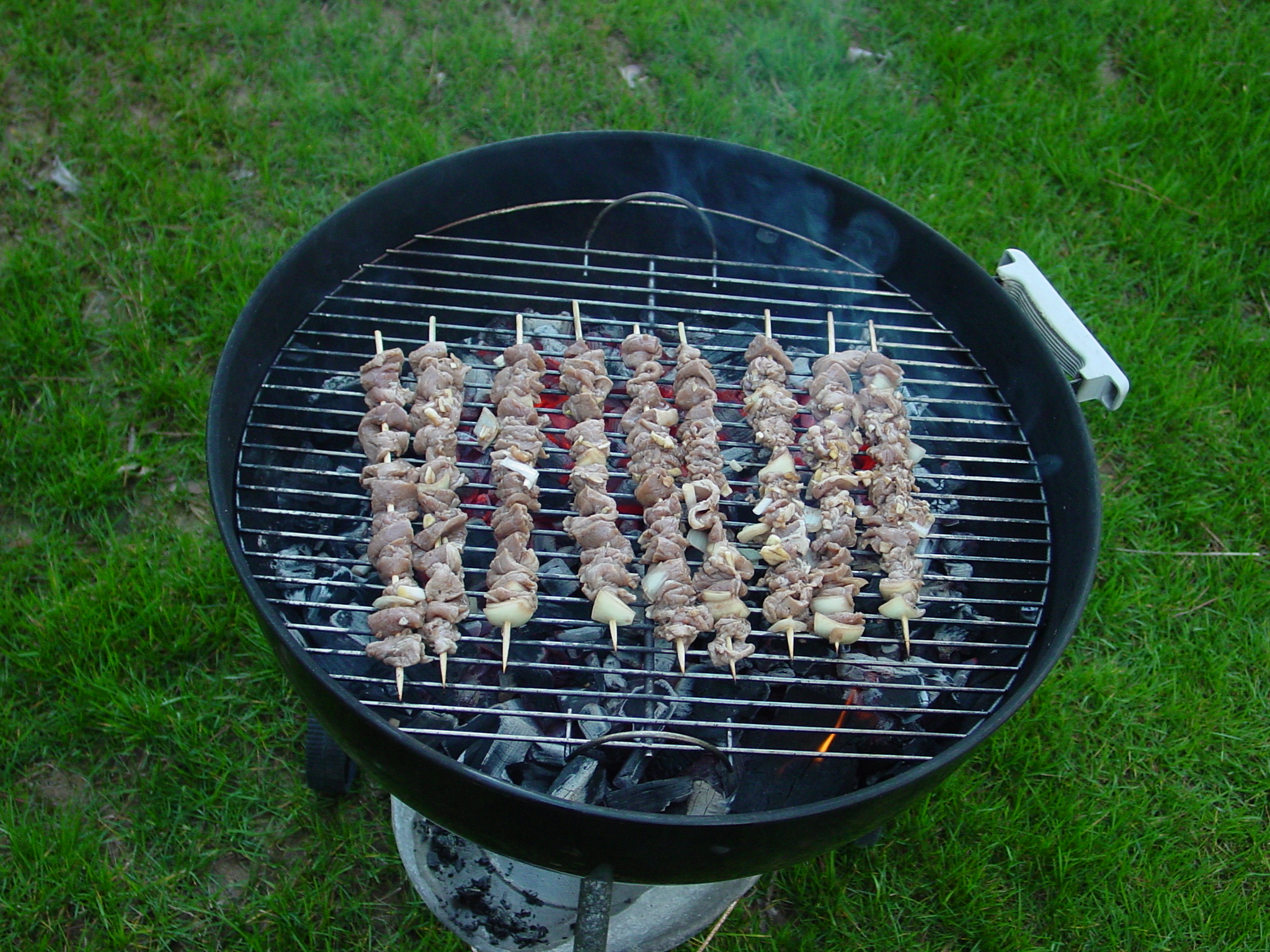
When the meat is done, plate it with the other elements of the meal described above and you should be left with a scene like
this. Each person at the table should fill their bowl with noodles, lettuce and cucumbers, and then de-skewer their desired amount of meat into the bowl. Then, splash in the sauce to lubricate (some add other elements, like peanuts, chunks of pineapple, some thinly sliced roasted shallots, some type of basil, lemongrass, other greens that one might tend to throw into pho, etc. at this stage), mix well and enjoy.
As for the wine to match, anything good that is chilled, white, crisp yet with hints of sweetness and, above all, at hand will do. I would recommend a really nice riesling, perhaps an orvieto, maybe a tocai friulano, and if you are really feeling special, a bottle of Jermann's Vintage Tunina.
Of course, if you are having some wine people to dinner and really want to show them that you're the balls, and not some chump who knows only what every chump should know or simply a show-off with show-off wines (ooooooooo, aaaaaaah, a Kistler chard: how creative; after all, that's never been done before), whip out a nicely chilled bottle of Soutomaior Albarino.
Posted by dag at April 3, 2006 3:40 PM
Comments
It's also worth noting that you should soak your skewers if you're using wood. This keeps them from lighting on fire. I love this dish, and tend to make it all the time. That is, when I actually have time...
Posted by: The Good Rabbi at April 5, 2006 8:57 PM